
DWC Research Analyzes Key Texas Return to Work Outcomes
A key report that examines return to work outcomes for injured employees in Texas has been almost lost in the COVID-19 pandemic. This spring the Division’s Research and Evalulation Group published Return to Work in the Texas Workers’ Compensation System, which analyzed RTW outcomes for the Texas workers’ compensation system between 2007 and 2017, including the percentage of injured employees who initially return to work after their injury; the percentage who remain at work; and the average days away from work.
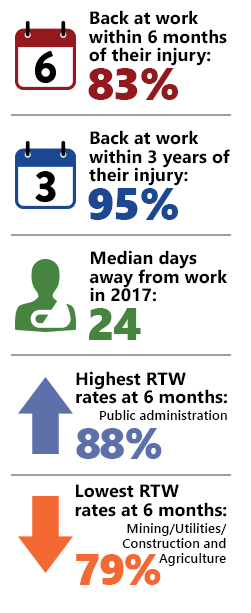 The report showed two types of RTW rates: initial RTW and sustained RTW. Initial RTW is the percentage of injured employees who returned to work for the first time after their injury. Sustained RTW is the percentage of injured employees who returned to work and remained at work for three consecutive quarters after their injury.
The report demonstrated several key findings regarding initial RTW, sustained RTS, wage recovery and days away from work following a compensable injury.
Initial RTW More injured employees are returning to work in Texas. About nine out of 10 injured employees return to work within one year of their injury.
Sustained RTW The sustained RTW rate has increased over time for all claim maturity levels. Almost twothirds of injured employees who return to work within six months post-injury remain at work in Texas.
Wage Recovery Those returning to work within six months of injury, on average, show a recovery to preinjury wage levels in about two years.
Days Away Injured employees who return to work within six months of injury have the fewest days away from work.
According to the REG report, the initial RTW rate has steadily increased for injured employees in Texas between injury years 2007 – 2017, from 78 percent of injured employees returning to work within six months post-injury in 2007 to almost 83 percent returning to work in 2017.
Moreover, in 2016, almost 65 percent of injured employees who went back to work within six months post-injury remained at work for at least three consecutive quarters, compared to about 60 percent in 2007. The sustained RTW rate has increased over time for all claim maturity levels.
Overall, the median days away from work is slightly lower in 2017 (24 days) than it was in 2007 (27 days), which means less lost income for injured employees and fewer disruptions to employer productivity. The mean days away from work shows a stable overall trend at roughly 42 days.
Researchers concluded that employer size appears to have a proportional relationship with initial RTW rates. Large employers have the highest initial RTW rates within six months post-injury, averaging at roughly 82 percent. Larger employers tend to have more robust RTW programs than smaller employers.
Finally, public administration has consistently demonstrated the highest initial RTW rates within six months post-injury at an average of roughly 87 percent. Meanwhile, employees in the mining/utilities/construction and agriculture sector have, on average, the lowest initial RTW rate at roughly 75 percent. Almost all sectors, except arts and accommodation, saw improvements in initial RTW rates over the last decade.
The REG research report is careful to point out that its analysis focuses on the RTW outcomes of injured employees who received temporary income benefits for their lost time. RTW rates were calculated using quarterly employee wage information from the Texas Workforce Commission.
Researchers also observed that several factors outside of the Texas workers’ compensation system affect RTW rates for injured employees, including the state’s economy, unemployment rates, industry changes, and changing employee demographics, among others. However, RTW rates are an important barometer of the overall effectiveness of a state’s workers’ compensation system.


 FOLIO
FOLIO
