
High Court Hears Arguments on Intentional Tort Exception to Exclusive Remedy
The Texas Supreme Court heard arguments this month in a case where a crane fell on an injured worker who was standing in the “fall path” of the equipment. The question is whether the injury was substantially certain to occur as a result of the defendant’s conduct, thus permitting the plaintiffs to avoid the exclusive remedy bar of the Workers’ Compensation Act through the intentional tort exception. Because of the CoVID-19 pandemic, the arguments were conducted electronically.
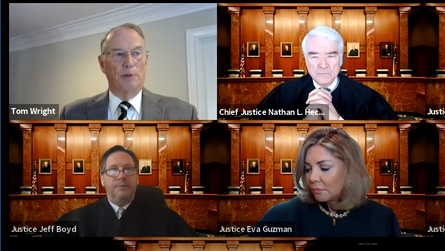 A principal issue in Berkel & Company Contractors Inc. v. Tyler Lee and Leigh Ann Lee, Cause No. 18-0309, is whether the court of appeals erred when it remanded the case for a new trial, in the interest of justice.
The court of appeals at first had reversed and rendered judgment against Lee, whose leg was crushed and later amputated when the crane fell under maneuvering stress. On rehearing, the court remanded, reasoning that its ruling on the intentional-tort exception (in reliance upon the Court’s June 12 Mo-Vac Service Co. v. Escobedo decision) justified a remand. (Ed.: We wrote about Escobedo in June 2020. See Navigating the Intentional Injury Exception to Exclusive Remedy.)
For the intentional-tort exception to apply in worker-comp cases, the Supreme Court held in Mo-Vac, that the employer must believe that its actions are substantially certain to result in a particular injury to a particular employee, not merely highly likely to increase overall risks to employees in the workplace. The court of appeals wrote:
We hold that injury was substantially certain only for someone in the fall path of the leads, and there is no evidence that Miller knew what that fall path would be. Without such evidence, a reasonable factfinder could not determine that Miller knew that his conduct was substantially certain to bring about harm to Lee as “someone within a small class of potential victims within a localized area.” See Restatement (Third) of Torts: Phys. & Emot. Harm § 1 cmt. e. At best, a reasonable factfinder could only determine that Miller knowingly created a risk of injury, which is insufficient to support liability under the intentional-injury exception. See Restatement (Third) of Torts: Phys. & Emot. Harm § 1 cmt. c, illus. 4 (providing that the substantial-certainty test is not satisfied when the actor merely knows that his conduct produces “a significant likelihood that someone will suffer physical harm”).
The lower court in Berkel determined its application of the substantial-certainty test’s requirements following the Mo-Vac decision required remand to allow Lee to support his argument that he was in a “danger” zone – a localized area – that Berkel’s supervisor knew would result in injury.
Much of the Supreme Court argument centered on the question of remand versus rendition of judgment. We anticipate that the Berkel decision may be issued before the end of the year.


 FOLIO
FOLIO
