
2020 Network Report Card Shows Networks have Become Ingrained into the Texas System
The Texas Division of Workers’ Compensation has released the results of the 2020 Network Report Card, authored by the agency’s Research and Evaluation Group (the REG). This report evaluates the performance of Healthcare Networks (HCNs) in the Texas workers’ compensation system. The September 2020 report details the impact the healthcare network choice has on delivery of benefits, health care costs, employee satisfaction with care and many other related issues.
The study concludes, “overall, the 2020 network report card continues to show that networks tend to be more cost-efficient than non-network claims, and these cost differences appear to be partially driven by lower hospital utilization and lower prices per service. Despite lower costs, network claims generally have better return-to-work and functional outcomes, compared with non-network claims. Network claims also tend to receive initial non-emergency medical care sooner than non-network claims, which studies have shown may assist in 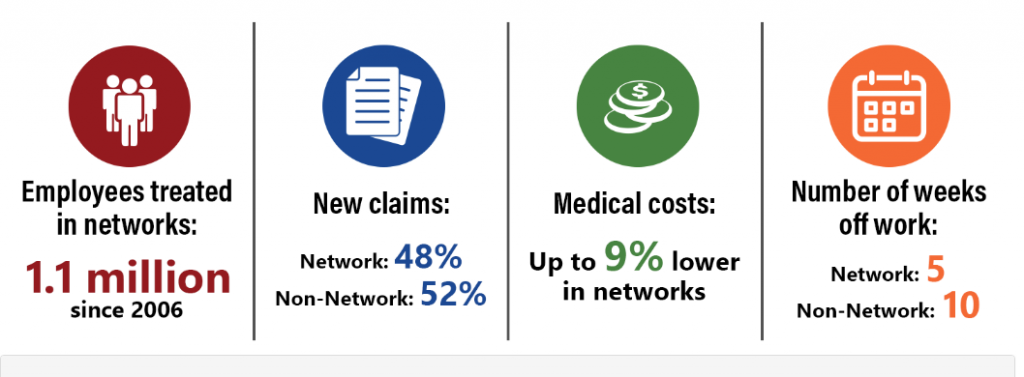 controlling medical costs and reducing unnecessary disability among injured employees.”
The Report Card outlines key findings from six important areas.
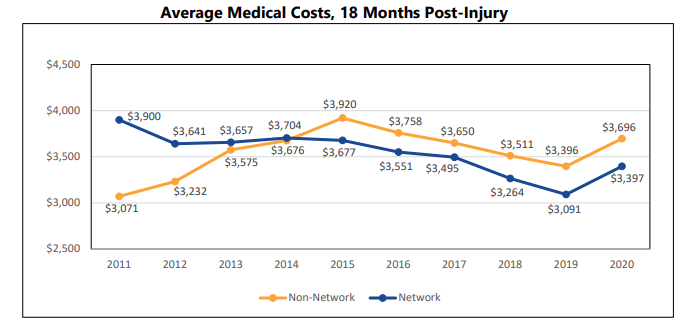
Medical Costs: Networks generally have lower medical costs per claim than non-network injured employees, especially at 18 months maturity.
Medical Utilization: A higher percentage of network injured employees received evaluation and management, physical medicine, and pharmacy services than non-network claims. A higher percentage of nonnetwork injured employees received hospital services.
Satisfaction with Care: While overall satisfaction with medical care was mixed for network and non-network claims, many network injured employees reported higher levels of satisfaction with their treating doctor. Regardless of network status, about 3 out of 4 injured employees reported that their work-related medical care was the same or better than the medical care they normally receive when injured or sick.
Access to Care: Overall, networks provided nonemergency care sooner after an injury than non-network claims. Most networks had a higher percentage of injured employees who reported that they had no problems getting needed medical care after their injury than non-network claims.
Return to Work: Overall, network claims had higher return-to-work rates than non-network claims.
Health Outcomes: Most network claims had higher physical and mental functioning scores than non-network claims.
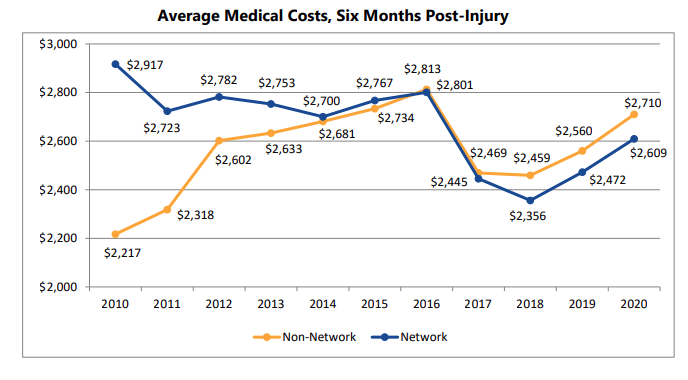
The REG determined that medical costs are generally lower for network claims than for non-network claims. From 2010 to 2016, networks had higher average medical costs per claim for initial care, compared to non-network claims. Since 2017, non-network average medical costs per claim at six months post-injury have been approximately 4 percent higher on average than network claims.
The medical cost gap widened between network and non-network claims at 18 months post-injury (using claims from the previous report card). Network medical costs were about 9 percent lower per claim at 18 months post-injury compared with non-network claims.
The report was authored by the Workers’ Compensation Research and Evaluation Group at the Texas Department of Insurance, Division of Workers’ Compensation. Under Chapter 405 of the Texas Labor Code, the REG is responsible for conducting professional studies and research on various system issues, including:
-
-
- the delivery of benefits;
- litigation and controversy related to workers’ compensation;
- insurance rates and rate-making procedures;
- rehabilitation and reemployment of injured employees;
- the quality and cost of medical benefits; • employer participation in the workers’ compensation system;
- employment health and safety issues; and
- other matters relevant to the cost, quality, and operational effectiveness of the workers’ compensation system.
-
Additional findings for each section of the report card, as well as a detailed description of the data sources and methods used to produce the report card results can be found in the 2020 Network Report Card Technical Appendix, which can be found at www.tdi.texas.gov/reports/wcreg/documents/netrc2020app.pdf.


 FOLIO
FOLIO
