Air Ambulance Cases Argued in the Texas Supreme Court
The Texas Supreme Court heard arguments in the air ambulance cases Monday, 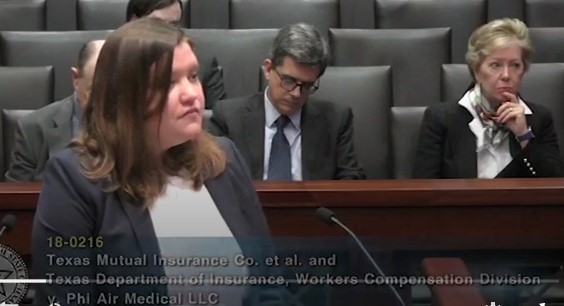 February 24, 2020, and the justices showed some level of skepticism toward the air ambulance providers’ arguments. The case pits Texas workers’ compensation carriers against providers of air ambulance services to workers injured following a work-related accident. Ambulance providers want no regulations on the amount of their services while comp carriers argue that the providers are subject to regulation by the Texas Department of Insurance, Division of Workers’ Compensation.
In December 2016 FOL published an FOL Advisory discussing the then current state of the litigation, which has been denominated as Texas Mutual Ins. Co. v. PHI Air Medical, LLC, Cause No. 18-0216. In that case, a Texas state district judge agreed with carriers that air ambulance bills were subject to state regulation by the Texas Department of Insurance and the Division of Workers’ Compensation.
The Third Court of Appeals disagreed, siding with the air ambulance providers’ argument that the Airline Deregulation Act preempted state regulation of their bills. The Texas Supreme Court granted the carriers’ petition for review and the case was argued this week. The arguments are archived and can be viewed here.
Assistant Attorney General Lisa Bennett urged the court to reverse the Court of Appeals’ judgment, on behalf of the Division of Workers’ Compensation. She was joined by Matt Baumgartner, who sought a similar result on behalf of Texas Mutual Insurance Company. The air ambulance providers’ position was argued by former Texas Supreme Court Justice Craig Enoch and his colleague, Amy L. Saberian.
While it is never safe to predict the outcome of an appellate case based on the questions a court asks, our view is that the air ambulance providers were presented with a number of challenging questions by the justices. For example, Justice Jimmy Blacklock pointed out that the natural result of the providers’ argument may affect the State’s ability to control Medicaid reimbursement rates, asking whether the State could “set a Medicaid rate for [an air ambulance] service if you’re right about what the law is?” Justice Enoch conceded that under the providers’ view, the State’s Medicaid program “would have to pay whatever [the air ambulance companies] charge.”
As the journal Business Insider recently pointed out, air ambulance bills are expensive.
In California, where no official medical fee schedule exists for air ambulance services, the state’s State Compensation Insurance Fund has seen its average payment per air ambulance bill increase 77%, said Stephen Hunckler, the fund’s San Francisco-based chief claims operations officer, in an email.
The Texas Division of Workers Compensation recently reported that it had 1,626 air ambulance bill disputes as of Dec. 2, 2019, with $48,000 being the average charge per transport in these disputes.
The dispute also implicates whether the air ambulance providers are permitted to balance bill injured workers for the amounts that remain unpaid after workers’ compensation carriers issue their checks. The providers argue that the statutory prohibition against balance billing is also preempted.
Appellate courts do not rule on appeals immediately. It is not unusual for the Supreme Court to take several months to decide a case of this magnitude.