Court of Appeals Finds Lunchtime Travel Case to be Compensable
The Corpus Christi court of appeals has concluded that an employee, who was traveling in his personal vehicle over the lunch hour, was fatally injured in the course and scope of his employment. The employee was scheduled to travel to a mandatory meeting later that afternoon.
The opinion in State Office of Risk Mgmt. v. Pena, 13-12-00712-CV, follows the 2014 reversal and remand in Pena v. State Office of Risk Mgmt., 13-12-00712-CV, 2014 WL 4494509 (Tex. App.—Corpus Christi Sept. 11, 2014, pet. denied). The case is a lunchtime-injury travel case.
Pena, the employee, worked for the Texas Health and Human Services Commission in it’s McAllen office. The Commission scheduled an off-site meeting, to take place in the Commission’s Edinburg office, beginning at 1:30 p.m. The meeting was a mandatory meeting.
Pena was released from work in McAllen at noon. His lunch hour was between noon and 1:00 p.m. He was compensated for 30 minutes’ travel time to get from McAllen to Edinburg. He was fatally injured in a motor vehicle accident at 12:06 p.m. The accident occurred at an intersection in McAllen located north of the HHSC offices and northeast of the employee’s home. There is no evidence of where the employee was headed at the time of the accident.
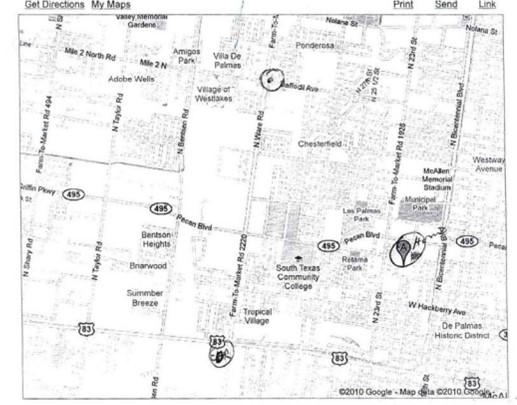
SORM argued that the accident occurred over the lunch hour and was not compensable. It argued in the alternative that the accident may have occurred while the employee was furthering both a business purpose (traveling to Edinburg for the meeting) and a personal purpose (traveling to get lunch). It also argued that if no one could prove where the employee was headed at the time of the accident, the claimant could not prevail.
The Division found the claim to be non-compensable. Pena filed suit for judicial review. SORM obtained a judgment in its favor via a motion for summary judgment. The Court of Appeals reversed that judgment and remanded the case for further proceedings. The court wrote:
We conclude that more than a scintilla of evidence exists that J.C.’s travel had a dual purpose. Accordingly, viewing the evidence in the light most favorable to appellant and crediting favorable evidence that a rational jury could have relied upon, we conclude that there is a question of fact regarding whether the dual purpose doctrine applies. See id. at 829 (“This determination [whether the two prongs of the dual purpose test applied] was a fact question for the jury.”).
On remand, the case was tried to a jury, which found that the employee was in the course and scope of his employment at the time of the injury. Again, no evidence was offered to explain where the employee may have been driving at the time of his accident. SORM appealed. The Court of Appeals affirmed the judgment.
Although the court discusses the dual purpose doctrine, it does not expressly apply the doctrine. In addition, although SORM argued that a travel case where the evidence failed to reveal where the employee was headed at the time of the accident was non-compensable (citing Davis v Texas Mutual Insurance Company, 443 S.W.3d 260 (Tex. App.—Dallas 2014, pet. denied).), the court rejected this argument on the basis that Davis involved the “continuous coverage” doctrine and this case did not.
SORM filed a petition for review to the Supreme Court of Texas in the first appeal. It is reasonable to believe that it will attempt to reverse this decision at the Supreme Court as well.