Non-Subscription Increased Among Small Employers; Remained Stable Among Large Employers
A new study by the Research and Evaluation Group at the Texas Department of Insurance measured non-subscription rates in Texas and has concluded that the number of employees covered by workers’ compensation has remained stable, although the percentage of small employers who offer comp to their employees fell. The research study, Employer Participation in the Texas Workers’ Compensation System: 2018 Estimates, was published on the Division’s website February 27, 2019.
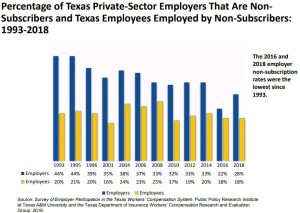
The study notes that private-sector employers have been allowed the option of whether to purchase workers’ compensation insurance since 1913. Texas is the only state that allows private-sector employers the option of not purchasing workers’ compensation insurance or becoming “non-subscribers” to the state system.
Several states’ laws have numerical exceptions that allow small private sector employers to be “non-subscribers.” The first study in Texas to estimate the percentage of employers that are “non-subscribers” to the Texas workers’ compensation system was conducted in 1993 with 11 follow-up studies between 1995 and 2018.
The report contains a number of findings that indicate that the Texas system remains healthy and cost efficient to employers and insurers. Among the significant findings, the REG found:
• Overall, the employer subscription rate fell from 78 percent in 2016 to 72 percent in 2018, but these two years remain the highest subscription rates since 1993.
• The percentage of Texas private-sector employees working for subscribers remained stable at 82 percent.
• In 2018, non-subscription rates increased among small employers and remained stable among large employers.
• The primary reasons subscribers say they buy workers’ compensation coverage are the ability to provide medical care to injured employees through networks and the lower premium rates.
• The primary reasons non-subscribers say they do not buy workers’ compensation coverage were that they had too few employees and few on-the-job injuries.
• Among large subscribers in 2018, the percentage that experienced premium decreases was the highest in eight years, the percentage that experienced increases was the lowest in eight years, and the percentage with unchanged premiums increased by 4 percent from 2016.
• The data used in the report consists of medical billing and payment data submitted by insurance carriers to the Texas Department of Insurance, Division of Workers’ Compensation, covering professional, hospital/institutional, dental, and pharmacy services. Claims are grouped as either ‘lost-time’ or ‘medical-only’ claims. Lost-time claims have more than seven days of lost time from work because of a work-related injury or illness and receive medical, as well as income benefits. Medical-only claims receive medical benefits, but not income benefits and have seven days or less of lost time.
• Overall, Texas non-subscribers report higher levels of satisfaction than subscribers.
• An estimated 64 percent of employees employed by non-subscribers are covered by non-subscriber alternative occupational benefit plans that pay either medical or wage benefits, or both to injured employees.
• Generally, more than 45 percent of Texas non-subscribers say they are extremely or somewhat knowledgeable about the workers’ compensation reporting requirements.
Per Chapter 405 of the Texas Labor Code, the Workers’ Compensation Research and Evaluation Group at the Texas Department of Insurance is responsible for conducting professional studies and research on various system issues, including: the delivery of benefits; litigation and controversy related to workers’ compensation; insurance rates and rate-making procedures; rehabilitation and reemployment of injured employees; the quality and cost of medical benefits; employer participation in the workers’ compensation system; employment health and safety issues; and other matters relevant to the cost, quality, and operational effectiveness of the workers’ compensation system.