Precedents: Causation and the Texas Intoxication Defense
National workers’ comp blogger Thomas A. Robinson recently reported on a Virginia court of appeals decision that applied that state’s intoxication defense. The court held that in order to defeat a claim for workers’ compensation benefits, it is not enough that the employer (or carrier) show that an employee was intoxicated at the time of his or her injury; the employer also bears the burden of proving that the intoxication caused the accident resulting in injury [see Andersen Interior Contr. v. Nimmo, 2017 Va. App. LEXIS 49 (Feb. 21, 2017)].
But, the Virginia rule is decidedly not the rule in Texas.
Texas Labor Code § 406.032(a)(1) provides that an insurance carrier is not liable for compensation if the injury occurs while the employee is in a state of intoxication. The defense requires no evidence that the employee’s state of intoxication caused the injury. It applies a zero tolerance standard to intoxication in the workplace.
In fact, the defense applies even when the employer may have originated and participated in the drinking of intoxicants. Texas Division of Workers’ Compensation Appeals Panel Decision No. 94160. In that decision, the appeals panel relied upon a 1953 decision from the Eastland Court of Appeals, Smith et al v. Traders and General Insurance Company, 258 S.W.2d 436, 438 (Tex. Civ. App.-Eastland 1953, writ ref’d), to deny the claimant’s claim.
Smith is a case that makes you shake your head and mutter, “only in Texas.” The claim began with a business trip from the Texas panhandle to Dallas. After conducting business, Smith and his boss, Mr. Williams, retired to room 717 on the seventh floor of the Jefferson Hotel in downtown Dallas.
Room 717 is where Smith’s boss produced a fifth of bourbon whiskey from his suitcase and invited Smith to have a drink. One drink led to another and soon, Smith and Mr. Williams had invited a third man, Mr. Hill to join them in the room.
One fifth of whiskey was apparently not enough for three Texans on a business trip, so Williams eventually sent Smith out with money to reinforce the supplies. Smith returned with two more fifths of whiskey and the three men got down to the business of serious drinking.
Around 10 p.m. the three men went to a tavern near the Jefferson Hotel in Dallas, Texas, known as the Water Front Cafe, and consumed several rounds of beer. As so often happens in such cases, drinks at the Water Front Café eventually turned into drinks at Squeege’s Bar, where eventually, the three men were asked to leave after some sort of “altercation” and the men returned to Room 717 of the Jefferson Hotel.
Around midnight Williams completely passed out on the floor of the hotel room. Smith was intoxicated but was able to stand on his feet and, so far as is known, did not pass out. At this point, some nature of altercation took place either between Hill and Smith or among Hill, Smith and Williams. Hill was struck in the mouth, the blow breaking a dental plate and knocking loose some of his teeth. Hill went to the bathroom “for the purpose of washing his face, spitting out his broken teeth.” According to Hill, while he was in the bathroom, Smith “in some manner fell from the window of the hotel room, and, as a result thereof, met his immediate death.” There was little controversy that Smith’s death resulted from an injury received while he was in a state of intoxication.
The court described these facts as “a complete defense” to the claim for death benefits, writing: “the fact that [Smith’s] employer may have originated and participated in the drinking of intoxicants with Smith has no bearing on the situation. Section (3) of Article 8309, section 1, is plain and unambiguous.”
The Smith case carriers a “writ refused” history, which indicates that the decision has the persuasive weight of an opinion of the Texas Supreme Court. Although Smith is an old law case involving an injury before the 1989 reforms to the Act, the relevant statutory language did not materially change from old law to new law. Accordingly, the appeals panel was able to cite Smith in deciding a new law case in Appeal No. 94160.
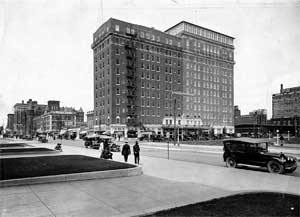
Who was the trial judge in Smith v. Traders & General, you ask? None other than Dallas District Court Judge Sarah T. Hughes, who Lyndon B. Johnson insisted be available to swear him in as the 36th President of the United States. Take a look at that picture of the Jefferson Hotel again. See the red building with the turrets behind and to the left of the hotel? That’s the Dallas County Courthouse, site of the criminal prosecution of Jack Ruby for the murder of Lee Harvey Oswald. And at the end of the street on the far left? That’s the intersection of S. Houston and Elm, or as it is more infamously known, Dealey Plaza, site of the assassination of our 35th President, John F. Kennedy.