
Precedents: Idiopathic Falls on Level Ground in Texas
If you stand on the corner of Travis and Texas streets in downtown Houston, you stand at the center of Texas history. On one corner, the Rice Building sits atop one of the most historic and fascinating pieces of real estate in all of Houston. Initially set aside by Augustus and John Kirby Allen for the Republic of Texas, the site served as home of the republic’s capital building from 1837 to 1839 and then again from 1842 to 1845. Later, the old capital building was transformed into the fabled Rice Hotel where Anson Jones, the last president of the Republic of Texas, committed suicide in 1858.
On another corner once stood the Chronicle Building, home to the Houston Chronicle. The ten-story tower was often called the “finest newspaper building in the South.” The Milby Hotel stood on the NW corner of Travis and Texas in the 600 block of Travis. The Milby made way for downtown Houston development and was demolished in 1971. The rest of the block on the east side of Travis was taken up by the Montgomery Ward building. Wards was across the street from the Iris Theater on Travis and across the street from the Rice Hotel on Texas.
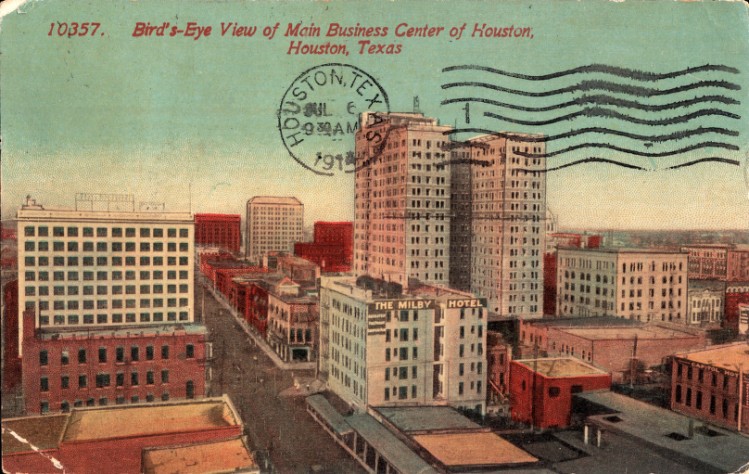 In 1948, the Supreme Court of Texas considered the compensability of a claim involving an idiopathic fall that occurred on the premises of that Montgomery Ward. The case informs our understanding of the compensability of idiopathic injuries under the Texas Workers’ Compensation Act.
Texas follows the minority rule in such cases. According to the Court, falls caused by either idiopathic (i.e., unknown) or known reasons, which result in injury because of the impact of the claimant’s body on the floor are compensable. Therefore, where an employee suffers a condition such as a seizure in the workplace and falls to the ground injuring a part of her body, we generally say that the seizure falls outside the scope of employment, but the injury from the fall is compensable.
The leading case, Garcia v. Texas Indem. Ins. Co., 209 S.W.2d 333 (Tex. 1948), involved a Montgomery Ward employee who, after suffering an apparent epileptic fit, fell and fatally fractured his temple on the sharp edge of a post. The jury found that the fracture could have in all probability caused the death. The court held the death compensable, saying that the fall resulted in an injury which was in turn a producing cause of death, “although the fall may have been due to a pre-existing idiopathic condition. . . . It is the injury arising out of the employment and not out of disease the employee for which compensation is to be made. Yet it is the hazard of the employment acting upon the particular employee in his condition of health and not what that hazard would be if acting upon a healthy employee.” (Emphasis added).
The Supreme Court revisited the compensability of idiopathic falls in Texas Employers Ins. Ass’n v. Page, 553 S.W.2d 98 (Tex. 1977), a case in which a security guard, while on duty, felt his knee buckle and fell on that knee on the parking lot surface. The court found that injury to be compensable as well. Other cases have reached the same conclusion. See General Ins. Corp. v. Wickersham, 235 S.W.2d 215 (Tex. Civ. App. – Fort Worth, 1950, writ ref’d n.r.e.) (Holding that the tile floor was an instrumentality of the employment); and American Gen. Ins. Co. v. Barrett, 300 S.W.2d 358 (Tex. Civ. App. – Texarkana 1957, writ ref’d n.r.e.) (Holding that a “hard-surfaced road was an instrumentality essential to the work of the employer”).
The Texas rule with respect to these types of injuries is the “minority” position. In his treatise on workers’ compensation law, Professor Larson is quite critical of the Texas approach, and he has noted that Texas is one of only a handful of jurisdictions that follow this rule. 1 Larson’s Workers’ Compensation Law §9.01 (2002). Nevertheless, it is the rule that has also been followed by the appeals panel. In Appeal No. 951576, the Appeals Panel stated:
While the facts of Wickersham and Barrett, involving level-ground falls, were certainly different from the facts in Garcia, the Supreme Court in Page cited these cases without distinguishing them nor retreating from the holdings articulated therein. (We note that Page, too, involved a level-ground fall.) That being the case, we are loath to ignore the language in those cases, which specifically rejects the carrier’s contention that an employee must demonstrate that the risk posed by the employment was higher than that encountered generally. Nor are we persuaded by out of state cases cited by the carrier; the decisions cited above, including Page, specifically refer to the fact that Texas is in the minority of jurisdictions on this issue. Alternatively, the carrier seeks to distinguish Wickersham and Barrett on the basis that “the particular ground to which the claimant was exposed was harder, perhaps, than ground generally” while the floor on which the claimant in this case fell was carpeted and thus “softer than ground generally.” While the decisions cited above do mention “the hard-surfaced road” (Barrett), “no evidence of anything unusual about the surface…a flat hard surface” (Court of Appeals in Page), and a floor “covered with tile” (Wickersham), we nevertheless cannot read into this language the requirement that the ground or floor be of a particular degree of hardness before the injury is compensable. A more likely rationale would be whether the surface on which an employee fell was sufficiently hard to cause the injury which ensued, since the injury must be caused by the instrumentality of the employer and not by the idiopathic or preexisting condition itself. Compare Texas Workers’ Compensation Commission Appeal No. 941056, decided September 21, 1994, in which the Appeals Panel found noncompensable a back injury caused solely by claimant’s sneeze and not by any instrumentality of the employer such as would have occurred if the sneeze had caused the claimant to actually strike his body on the equipment he was operating. That decision cited the case of Director, State Employees Workers’ Compensation Division v. Bush, 667 S.W.2d 559 (Tex. App.-Dallas 1983, no writ), which found noncompensable an employee’s fall from a stretcher on which she had been placed after fainting due to her high blood pressure. While the claimant in that case sought to rely upon the Garcia rationale, the court wrote, “[W]e agree that if Bush had fallen at the time of her initial fainting and had been injured by hitting the floor or any other instrumentality of her employer’s business, her injury would clearly lie within the criteria of Garcia and its progeny.” See also Texas Workers’ Compensation Commission Appeal No. 93956, decided December 8, 1993. In the instant case, however, whether the claimant in falling struck a carpeted floor, it clearly was with sufficient force to cause a skull fracture. Therefore, we reject carrier’s contention that this case is distinguishable simply because the claimant fell on a “soft” surface.
We also reject, for reasons articulated above, the carrier’s argument that a fall onto a floor is analogous to an “ordinary disease of life” to which the general public is exposed. Nor do we find persuasive the argument that the ground constitutes an “act of God” which, the 1989 Act requires, must be shown to pose a greater risk to an employee than ordinarily applies to the general public. Section 406.032. We also reject the carrier’s analogy to cases involving transportation to and from work (“going and coming” cases) which, by statute (Section 401.011(12)(a) and (B)) and case law are not compensable unless one or more certain stated exceptions are found to exist. While the rationale behind that provision is admittedly that an employee is exposed to no greater hazard upon roads and streets than is the general public that analysis has not been applied in the foregoing Texas cases regarding falls.
As recently as 2005, the Appeals Panel has affirmed the application of this rule to a Texas claim. In fact, in Appeal No. 051610-s (a “significant decision”), the Appeals Panel held that the employer does not even have to own the floor on which the claimant was injured; it was simply enough that the employment exposed the claimant to that floor.
It is important to remember that in these cases, the compensable injury is usually only the injury caused by the collision with the floor. If the fall was caused by another condition, such as a seizure or a stroke, that condition is not compensable unless it can be independently shown to be compensable under the act.


 FOLIO
FOLIO
