
Precedents: Mystic Causation
It is the summer of 1975, and three blue-collar Boston kids’ lives will never be the same after one of them is kidnapped. Years later, haunted by the incident, the three friends’ lives intersect again when one of their children is murdered. The  case looks like it is going to be broken when ballistics links a gun to the crime. But the gun owner passes a polygraph test!
Did you recognize the plot to the 2003 mystery thriller, Mystic River? And do you know that modern day Texas extent of injury cases trace the rule that they follow to a criminal case involving the use of the polygraph, otherwise known as the lie detector?
Here’s how that happened.
In Texas Workers’ Compensation Appeals Panel Decision No. 120311-S, the appeals panel’s resolution of an extent of injury dispute relies on precedent that originates from a case adjudicating whether polygraph testing results are admissible.
The issue in APD No. 120311-S? Whether the claimant’s compensable injury extended to a stress fracture of the left second metatarsal, as argued by the claimant and her treating surgeon, or whether the injury was a non-compensable a follow-on injury as contended by the carrier.
The carrier won the CCH. The hearing officer concluded that the treating doctor’s opinion was unreliable under Texas law because it failed to adequately rule out other possible causes of the stress fracture, such as the claimant’s preexisting osteoporosis or her diabetes. The hearing officer concluded that the treating doctor erred in failing to apply this “differential diagnosis” analysis to the case.
On appeal, the appeals panel first recognized the general rule in Texas that:
[P]roof of causation must be established to a reasonable medical probability by expert evidence where the subject is so complex that a fact finder lacks the ability from common knowledge to find a causal connection. See Appeals Panel Decision (APD) 022301, decided October 23, 2002. See also Guevara v. Ferrer, 247 S.W.3d 662 (Tex. 2007). To be probative, expert testimony must be based on reasonable medical probability. City of Laredo v. Garza, 293 S.W.3d 625 (Tex. App.-San Antonio 2009, no pet.) citing Insurance Company of North America v. Meyers, 411 S.W.2d 710, 713 (Tex. 1966).
The appeals panel disagreed, however, with the hearing officer’s conclusion that the claimant’s expert had to rule out other possible causes. The appeals panel wrote that the hearing officer’s analysis in this respect “misapplied the law” and that the error required a remand.
So, where does the lie detector come in?
Relying upon the 1993 United States Supreme Court opinion, Daubert v. Merrell Dow Pharmaceuticals, and its 1995 Texas Supreme Court counterpart, E. I. du Pont de Nemours & Co., Inc. v. Robinson, the appeals panel wrote, “An analysis of other possible causes of an injury or illness is a factor to consider when determining causation.”
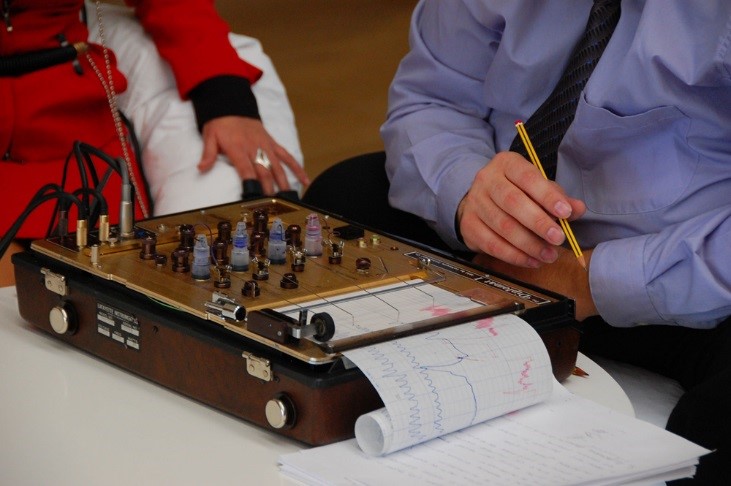 But Daubert overturned a 1923 federal case that said that excluded expert opinions that were based on a scientific technique unless the technique was “generally accepted” as reliable in the relevant scientific community. This decision, established the “Frye” test, and ruled that evidence offered by James Alphonzo Frye, an alleged murderer, that he had passed a “systolic blood pressure deception test” – a lie detector test – was not admissible to establish his innocence. The court wrote:
Just when a scientific principle or discovery crosses the line between the experimental and demonstrable stages is difficult to define. Somewhere in this twilight zone the evidential force of the principle must be recognized, and while courts will go a long way in admitting expert testimony deduced from a well-recognized scientific principle or discovery, the thing from which the deduction is made must be sufficiently established to have gained general acceptance in the particular field in which it belongs.
We think the systolic blood pressure deception test has not yet gained such standing and scientific recognition among physiological and psychological authorities as would justify the courts in admitting expert testimony deduced from the discovery, development, and experiments thus far made.
The Frye test was the law of the land for 70 years. But Daubert and Robinson replaced it with a more modern causation standard. And the appeals panel has applied that newer standard to Texas workers’ compensation cases.
The hearing officer must utilize the proper legal standard in analyzing and weighing the evidence in this case, which includes the medical opinion of Dr. D, the claimant’s treating surgeon, who causally related the claimed stress fracture of the left second metatarsal to the work injury of [date of injury], as well as the claimant’s bone scan.
In analyzing medical causation issues, the appeals panel does not require a physician to rule out every possible cause of a condition. We wouldn’t lie to you about that.


 FOLIO
FOLIO
