
Supreme Court Rules that OCIP Agreement Precludes Suit Against Subcontractor
On June 3, 2016, a unanimous Texas Supreme Court further solidified the exclusive remedy provisions of the Workers’ Compensation Act in a case involving an Owner Controlled Insurance Program. The court harmonized two arguably conflicting provisions of the Act and concluded that a general contractor’s employee was the fellow servant of the employees of a subcontractor on the jobsite. Thus, the exclusive remedy provisions of the Act precluded the employee’s lawsuit against the subcontractor.
TIC Energy & Chem., Inc. v. Martin, No. 15-0143 (Tex. June 3, 2016) involved a case where Kevin Bradford Martin, an employee of Union Carbide Corporation, a jobsite general contractor, sued TIC Energy & Chemical, a subcontractor on the jobsite, alleging that the subcontractor’s negligence was a proximate cause of an accident that resulted in the amputation of Martin’s leg. Schematically, the case looked like this:
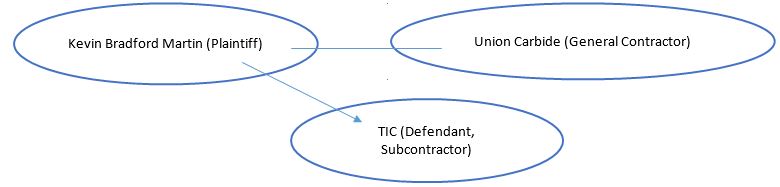
Martin sought and received workers’ compensation benefits from the OCIP’s workers’ compensation carrier and then sued TIC. He claimed that the subcontractor was an independent contractor and that the subcontractor had entered into an agreement with the general contractor whereby it “assume[d] the responsibilities of an employer for the performance of work.” Martin argued that the subcontractor was not a deemed employer under § 406.122 of the Act. TIC argued that it was entitled to the exclusive remedy bar under § 406.123. The case, then, set up a dispute regarding the relationship between §§ 406.122 and 406.123.
The court described the issue as follows:
The issue in this personal-injury case is whether a subcontractor is entitled to the exclusive-remedy defense as a fellow employee of the general contractor’s employees by virtue of the general contractor’s written agreement to provide workers’ compensation insurance to the subcontractor. Under section 406.122(b) of the Labor Code, a subcontractor is not an employee of the general contractor if the subcontractor (1) is operating as an independent contractor and (2) has agreed in writing to assume the responsibilities of an employer for the performance of the work. However, section 406.123 of the Labor Code expressly confers statutory-employer status on general contractors who provide workers’ compensation insurance to their subcontractors pursuant to a written agreement. This case involves a written agreement that ostensibly meets the terms of both sections.
The trial court and the court of appeals had both concluded that the two sections conflicted and that, therefore, the subcontractor was not entitled to rely upon the exclusive remedy protections provided by the OCIP. The Supreme Court disagreed that the two statutory provisions were in conflict.
Section 406.122 defines the employment relationship between the general contractor and those laboring in service of a general contractor. Section 406.122(a) identifies those who are deemed to be a general contractor’s employee: any person who performs work or provides services to the general contractor, unless the person is an independent contractor or an employee of an independent contractor. Subcontractors may be independent contractors and vice versa, but the terms are separately defined in the statute, indicating some distinction is intended. Section 406.122(b) affirmatively excludes subcontractors as the general contractor’s employees if they are operating as an independent contractor and have a written agreement evidencing the relationship. Section 406.123 in turn provides for an election by which a general contractor may become a statutory employer by agreeing, in writing, to provide workers’ compensation insurance to the subcontractor. Taken together, the only plausible reading of the statute is that section 406.122 states a general rule of employment status for workers’ compensation purposes and section 406.123 deviates from that rule by creating the fiction of another.
The court then found that the OCIP in this case fell into the exception to the general rule. Such a reading, the court wrote, “is consistent with the subchapter’s structure, section 406.123’s purpose, and our precedent.”
Martin’s strained construction runs counter to the statutory text because the exclusive-remedy provision only bars claims by an “employee” against an “employer.” If lower-tier subcontractors are not employees, then none of the higher-tier contractors could claim the defense. An interpretation that produces such a consequence is not only contrary to our holding in HCBeck, it is also counter to the Workers’ Compensation Act’s reciprocal-benefit scheme and defies logic.
The court wrote that Martin’s argument “misses the mark” because “exclusive-remedy immunity goes both ways.” The court explained that if Union Carbide’s employees are co-employees with TIC, Union Carbide’s employees enjoy the same statutory immunity that TIC enjoys. Neither party could be sued by the employees of the other. Moreover, the employees of each party were assured of a workers’ compensation recovery. As the court put it, “mutual protection from personal-injury claims by those engaged in a common endeavor is valuable and a significant component of the statutory scheme.”


 FOLIO
FOLIO
